
I've been a middle school librarian for over 27 years and I believe that middle school kids deserve great books! Learn more at youngteenlit.com
Saturday, March 29, 2014
The Tomorrow Code by Brian Falkner
Tane and Rebecca, two teenagers from New Zealand, decode a cryptic computer message send through outer space, and discover winning lottery numbers. They also discover that the message came from themselves in the future, and that winning the lottery is just the beginning of what they need to do to save the world from complete devastation. They start on a quest to follow their own instructions that leads them to buy a mini-submarine, invade an island research lab, and try to save humanity from a bizarre cloud of destruction. I can't begin to explain the science behind all this—to me it was wildly implausible. But my middle school students love this book, and I will admit that it had me wanting to read to the end. Recommended for middle school kids who like science fiction, dystopia, and action.
Me, Him, Them and It by Caela Carter
Evelyn has some serious problems. In her efforts to annoy her distant and difficult parents, she starts to party and be a "bad girl." When she gets involved with a guy she doesn't care about and becomes pregnant she doesn't know where to turn. All she knows is that she can't possibly terminate her pregnancy. But who can she trust? Where can she go? The father of the baby has checked out. Her best friend is angry at her. Her parents idea of supporting her is to send her to live with an aunt in Chicago. Evelyn is mixed up and self-centered and smart, and her journey through adult decisions is both frustrating and fascinating. I kept wanting to read just to find out what (and when) she would finally decide to do. This is definitely a book for high school and up, and is recommended for readers of realistic fiction who like stories about emotional growth.
Lincoln's Grave Robbers by Steve Sheinkin
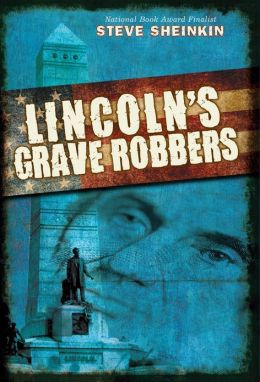
Did you know that the U.S. Secret Service started out as a group of men who were working to stop counterfeiters from producing fake money? Back in the 1800s is was relatively easy to create counterfeit money, but it was difficult to actually make really good counterfeit bills. A man named Benjamin Boyd was very good at making fake money, and he made a lot of money at it. But he ended up in prison, and that's when a group of Chicago men came up with a plan to get Boyd out of prison. Strangely enough, that plan included stealing the dead body of President Abraham Lincoln and holding it for ransom. This book tells the story of the grave robbing plot as well as the story of the Secret Service agent whose job it was to stop the robbery. The book is a quick read that includes photographs of the people and places involved. I learned a lot from this book, and enjoyed adding to my knowledge of United States history. There are many characters, both good guys and bad guys in this story, and the hardest thing about this book was keeping track of who was who. Recommended for 6th grade and up.
Monday, December 09, 2013
Heaven is Paved with Oreos by Catherine Gilbert Murdock
Fourteen-year-old Sarah Zorn and her best friend Curtis tell people they are dating just to get them to stop wondering. The truth is they are best friends and they do science projects together (like reconstructing the skeleton of a dead calf). Things change when Sarah's hippie grandmother takes her on a pilgrimage to Rome and Curtis decides he wants to stop pretending to be boyfriend and girlfriend. This book is Sarah's journal of her trip and her changing feelings for Curtis. It's also the story of family secrets that her grandmother brings to light on the Spanish Steps in Rome. It's a sweet story about travel, family and romance that would be great for middle school girls. BONUS: It's also the companion book to Dairy Queen, which is one of my all-time favorite young adult novels. Curtis is D.J. Schwenk's quiet younger brother and D.J. and Sarah get to be friends in this book. Hopefully this will become a gateway book for middle schoolers to move on to Dairy Queen.
Monday, November 25, 2013
The Here and Now by Ann Brashares
In the not-so-distant future, a mosquito-bourne disease has killed off most of humankind. A small group of immune people survive and they have the technology to travel back in time. A group of "travelers" head back to 2014 to try to head off the disastrous future that they know is coming. The day they travel to 2014, a "time native" named Ethan sees a naked girl appear by the river where he is fishing. He notices a number written on her arm. He gives her a sweatshirt and she wanders away, but he never forgets her or her number. A couple of years later she shows up in one of his high school classes. Prenna lives by the rules of her people—she can never tell where she is from, never interfere with history, and never be intimate with anyone outside of her community. She tries to stay away from Ethan but they have a strong connection and when a homeless man tells them the meaning of the number that was on her arm, they learn that they need to take some action together. I enjoyed this book a lot—it's got romance, action, and time travel, and characters that you end up caring a lot about. Recommended for 7th grade and up. (My copy was an advance copy from the publisher. The book will be published in April 2014. Galloway students can borrow my copy until then.)
Reboot by Amy Tintera
Imagine a world where people die and come back to life. It seemed like a good thing in this future society where there was a fear that the human race was dying off. However, people came to fear the "reboots" and humans decided to enslave them and use them to fight battles too dangerous for people to fight. Reboots are known by a number—the number of minutes they were dead before they rebooted. The main character of this book is 178. It's a scary-high number, because it's common knowledge that the higher the number the less human a reboot can be. 178 doesn't is an excellent fighter (and killer) and doesn't feel very human herself until she becomes the trainer for 22, an unusual reboot who hasn't yet learned to give up his humanity. When they find out there may be humans and reboots who want to rebel against the system they find the courage to leave their prison and head off to the slums of Texas. And yes, they also find some romance along the way. This book was strong on action, especially in the last half of the book. The problem for me was that I didn't fully get invested in the characters. I thought it was a pretty good book but it borrowed a lot from other dystopian books and didn't rise to the level of The Hunger Games or Starters or Unwind, or The 5th Wave, which are some of my favorites. Still recommended for dystopia fans, though. Probably best for 8th grade and up.
Thursday, November 14, 2013
Nantucket Blue by Leila Howland
From the cover this looks like a breezy summer romance book,
which it is in a way, but I didn’t find it quite as satisfying as I thought I
might. The main character, named Cricket, spends much of her time with her best
friend, Jules, and her family, partially to avoid her own divorced parents.
When Jules’ mother dies unexpectedly, Cricket finds herself rejected by her
best friend, uninvited to stay at their Nantucket home for the summer, and on
her own to find a summer job on the island. It’s not the romantic summer she
was expecting, but it has its surprises and an unlikely romance (and Cricket’s
first sexual encounter). I was moderately interested in this story but I found
that I didn’t really like Cricket or Jules, and there was too much going on for
me to get very attached to their story (a dead senator, an adopted stepbrother
from Russia, a long-lost tell-all diary of Cricket’s mom). This one was just
so-so. For a truly breezy romance I recommend This is What Happy Looks Like byJennifer E. Smith.
Tuesday, November 12, 2013
Hidden by Helen Frost
Darra and Wren were eight years old when Darra’s father stole a
car and kidnapped Wren in the process. The two girls never met at the time but
their stories intertwined and they have unresolved questions about each other.
When they meet six years later at summer camp they instantly know each other
but it takes some time before they are able to slowly connect and talk openly about their shared past. This is a really unique book, both in its plot and its
form. The free verse style makes it a quick read and deceptively simple. The
characters are intriguing, the summer camp setting is perfect for their cycle
of emotional growth, and in the end readers discover some hidden messages in
Darra’s passages. While the poetic form makes the book unique, at the same time
it meant that the book did not go into great detail. I enjoyed the story but
felt like I would have connected with the characters more had there been more
meat to the writing. I also thought the additional hidden story line in Darra’s
narrative (see the author's note for an explanation), didn't deliver any surprising additions to the plot. Overall I did enjoy this book and I will recommend it to middle schoolers, especially reluctant readers.
Letting Ana Go by Anonymous
Kids today probably don’t know Go Ask Alice, the young adult novel from 30 years ago that was
supposedly the true diary of a girl sinking deeper and deeper into drug
addiction. Letting Ana Go is
obviously a modern twist on this style—a cautionary tale told in the first
person about a young person who slowly goes from being a good girl with
everything going for her to a psychological disaster. The narrator has no real reason to
diet except that she runs cross country and needs to track her calories to be
sure she is eating enough. However, her best friend, Jill, is a ballet dancer who
begins losing dangerous amounts of weight in order to further her dance
ambitions. The narrator counts calories in solidarity with Jill at first, but then finds that
she gets positive attention from her new boyfriend (Jill's brother) and that it helps her deal with her parents' breakup. She soon becomes unable to stop her dangerous behavior. I am no expert on
anorexia. I cannot say whether this book accurately represents the progression
of this disease, but I can say that it did not ring true to me. The narrator's descent
into the disease happens rather quickly and her health also fails too rapidly
for me to believe. I found it hard to suspend my disbelief enough to think that
this girl really would have let this disease get the best of her. I think there
is a subset of teen and pre-teen girls who will like this book because of the
subject matter and the appeal of “problem novels” but I cannot say that I
recommend it to readers in general. If you really want a chilling look at
eating disorders try Wintergirls by Laurie Halse Anderson.
Thursday, October 24, 2013
The Familiars by Adam Jay Epstein and Andrew Jacobson
This animal fantasy book contains all the elements of a traditional fantasy—it begins when a young protagonist who feels ill-equipped for greatness is chosen for a seemingly impossible task. Aldwyn the alley cat is selected by a young wizard-in-training to be his familiar. Aldwyn is assumed to be telekinetic and will be the boy's companion and protector. He meets two other familiars, a frog and a bird, and they soon must rescue their "loyals" from almost certain death at the hands of an evil queen. The band of three familiars sets off on a pretty predictable quest to save their loyals and along the way they run from spies and fend off an eight-headed dragon. This is a good introduction to fantasy for readers who may not yet have read widely. While is loved by third and fourth graders at my school, the middle school readers mainly thought it just didn't break any new ground for them. I had trouble getting through it also, but I am admittedly not a fan of animal fantasy.
March by John Lewis, Andrew Aydin, and Nate Powell
I thought this graphic novel was fantastic. It tells the story of one of my heroes, civil rights activist John Lewis. It begins on a bridge in Selma then moves to his congressional office on the day of Obama's inauguration. The story then flashes back to Lewis's childhood on a farm raising chickens. We see him make it to college (a remarkable accomplishment at the time) and decide to join in the movement to desegregate lunch counters. This is Book One so we must wait for future books to hear about the Freedom Rides and the March on Washington. It's a great story with fine artwork and I hope it introduces many new young people to John Lewis's contributions to the Civil Rights Movement.
Monday, September 30, 2013
The Nazi Hunters by Neal Bascomb
I love reading a good nonfiction book about a topic that is new to me. I vaguely knew that a lot of Nazi war criminals escaped to Argentina, but I had never heard the story of how Israeli spies tracked down the notorious Adolf Eichmann and brought him to trial in Israel. Eichmann was the head of the SS during World War II. It was his job to carry out Hitler's plan to exterminate the Jews. He was a powerful and arrogant man during the Holocaust, but he disappeared in 1945 when Germany lost the war. Years later, most of the world had given up and tracking down Nazi criminals, but many Holocaust survivors and people living in Israel still wanted to bring public justice to the worst perpetrators of the genocide. Amazingly enough, Eichmann was first discovered to be living in Argentina by a teenage girl and her blind father. It took several years for officials to believe their story and for Israeli spies to devise the elaborate plan to capture Eichmann, hold him as a secret captive in Argentina, and fly him to Israel—all without the Argentine government finding out anything. The details of how the capture was made are fascinating. This makes for great reading, especially for fans of history and spy books.
Friday, September 27, 2013
Rose Under Fire by Elizabeth Wein
I love historical fiction and particularly enjoyed Elizabeth Wein's previous book, Code Name Verity. This follow-up book, which isn't a sequel but shares one character, was also a great read. Rose is a young American pilot working in Britain during World War II. She longs to fly to Europe instead of ferrying airplanes around the UK. On her first chance things go wrong and she is captured and sent to Ravensbrück, a women's concentration camp that I knew nothing about before reading this book. While there she is taken in by a group of women called the "rabbits" because they were the subjects of horrific medical experiments done by Nazi doctors. The whole concentration camp experience is awful, as you can imagine, but this book is so full of humor and humanity and daring that it is inspiring rather than depressing. I appreciated that the book did not end in the camps, rather it went on to show the aftermath for those who survived. This is a book about friendship and the power it can have to overcome the worst circumstances in the world. The best part of the book for me? Rose is also a poet who loves the poems of Edna St. Vincent Millay. Millay's poems are interwoven throughout the text as are poems that Rose writes. Elizabeth Wein, a pilot herself, is an outstanding writer and this is a must-read for historical fiction lovers. My review isn't going this book justice, so please see this review of Rose Under Fire as well.
Monday, September 02, 2013
The Language Inside by Holly Thompson
Emma is an American teenager who has grown up in Japan. When her mom needs breast cancer treatment, Emma is uprooted and brought to Massachusetts to live with grandparents. This free verse novel explores Emma's reverse culture shock as she adjusts to life in the United States. Emma is a girl who wants to help others—she is torn by the fact that she cannot be in Japan helping victims of the recent tsunami even though she knows she needs to be with her mother during her treatments. She signs up to volunteer at a nursing home and is paired with a stroke victim with whom she writes poetry. At the nursing home she also meets a Cambodian immigrant named Samnang who becomes a friend and a possible love interest, and through him she finds a way to contribute to relief efforts in Japan. While it seems like this book might have too much going on, it's really a quiet, reflective book about a year in the life of an sensitive and introspective teenage girl. I enjoyed it a lot and passed it on to Ms. Chapman, the teacher with whom I traveled to Cambodia this summer. It will especially appeal to readers who are interested in Japanese or Cambodian culture.
To Be Perfectly Honest by Sonya Sones
To be perfectly honest, I didn't really like this book. I have liked Sonya Sones' books in the past but this one is short on characterization. The main character, Colette, is the 15-year-old daughter of a famous movie star who is neglected by her mom most of the time. She lies all the time about both big and small things (and to her credit she knows this—in fact, she tells you she is an unreliable narrator). In this story she and her younger brother, Will, are living in a hotel pretty much on their own while their mom is filming a movie. Colette meets a somewhat older boy who seems interested in her and doesn't know she is the daughter of a movie star. I didn't see much reason for her to be in love with Connor except that he drives a motorcycle and is handsome. I also didn't see much motivation for Connor to be interested in Colette, but the book is full of her romantic dreams and their encounters, and his attempts to go farther with her than she is ready to go. It's also a little creepy because we know all along that he is 18 and she is underage (and Colette's mom doesn't seem to care). Then (spoiler alert) he tells her his deep dark secret which only makes her love him more but then turns out to be a lie. Colette's mom doesn't seem so bad in the end and Colette learns a valuable life lesson. I don't think high school students would buy this story—it's just a little too predictable and trite, but due to the sexual issues explored here I wouldn't recommend it for younger readers. (And that little brother's lisp was really annoying.)
Subscribe to:
Posts (Atom)


